Published:
Cable theft has cost UK solar farms an estimated £7.1 million since January 2022, according to police data, with earthing cable — stolen for scrap value — accounting for 43% of all reported thefts.

Above: Secured By Design Has Produced New Guidelines For Solar Farms
Reported offences against solar, onshore wind and battery storage sites rose 59% year-on-year in 2025, and copper prices are up around 25% since late 2025: solar sites are now planned targets, not just opportunistic ones.
The response has landed. Police Crime Prevention Initiatives (Police CPI), which runs the Secured by Design scheme, has published a new Solar Farm Guide, created with the National Infrastructure Crime Reduction Partnership (NICRP) and backed by Solar Energy UK. It’s the first document of its kind to spell out, in detail, what proportionate security for a solar development actually looks like.
Deer and stock fencing, historically the default choice on UK solar sites, was designed to keep livestock in, not stop an organised, determined attack. It was never a security measure. Now there’s a police- and industry-backed standard confirming it.
For developers and planners with sites still in the pipeline, this guide is not background reading. It is the new reference point.
Why This Matters More Now Than It Would Have Five Years Ago
Solar is no longer a niche part of the UK’s energy mix; it is becoming core national infrastructure under the government’s Clean Power 2030 mission. The goal is to increase solar capacity by more than two and a half times by the end of the decade, from around 18GW today to roughly 45–47GW, which means a substantial pipeline of new developments.
Every one of those projects will have to make a perimeter security decision somewhere in the design process. Get it right early and security is embedded from day one; get it wrong and it may become an expensive retrofit later, after planning permission, during construction, or only once the first theft occurs. That matters because solar farms are long-lived assets, often designed to operate for 25 to 40 years, so mistakes in the pipeline can lock in risk for decades.
That is why the timing of this guide matters. It has arrived while a large share of the UK’s future solar capacity is still at the planning or pre-planning stage, meaning many schemes may now need to revisit their security specification against a standard that did not exist when they were first submitted.
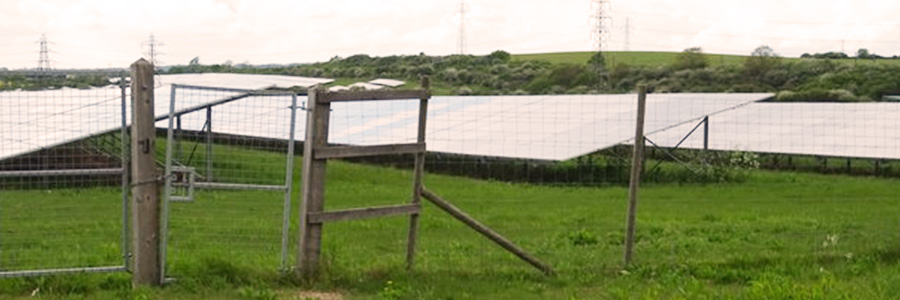
Weak Perimeter Security Does Not Deter or Delay Attacks Effectively
The Crime Picture Behind The Guide
This is not a theoretical risk. NICRP’s own reporting puts national losses from solar farm theft at over £1 million in January and February 2024 alone, including a single £150,000 loss in the Wiltshire force area. DeterTech, which holds a live data-sharing agreement with all 43 UK police forces, recorded at least 70 reported offences against solar farms between January and August 2024, and in more than 20% of those incidents, over 20km of cable was stolen in a single hit.
The pattern is not opportunistic; it is organised and repeatable. Documented cases include coordinated distraction tactics, luring security patrols away from site while a second team strips cable, and repeat attacks on sites already hit once, such as the £90,000 of cable stolen from a Derbyshire solar farm across three break-ins in one month.
The incentive has only grown. Reported offences against UK solar, onshore wind, and battery storage sites rose 59% year-on-year in 2025, while copper prices were up around 25% since late 2025, making every raid more attractive to criminal groups.
That is the backdrop against which the new Secured by Design guide was written: not a future possibility, but a documented, organised, and accelerating threat.
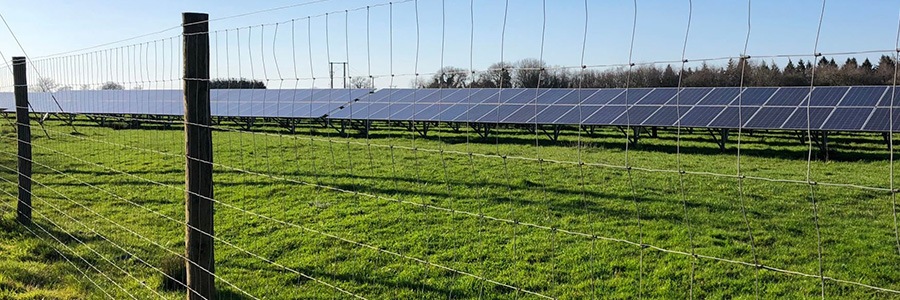
Deer Fencing Has Been Standard On UK Solar Farms – But Is It Time To Upgrade?
Deer Fencing Was Never A Security Decision — It Was A Default
Police have been making this point for years, long before the new guide arrived. Designing Out Crime Officers, the police specialists who review site security at planning stage, have repeatedly flagged the same weakness on solar applications across multiple forces: Derbyshire Police have warned that deer fencing and hedging “will provide an inadequate deterrent,” while Northumbria Police have gone further, stating that stock proof boundary fencing “would provide little deterrence value at all.” Neither force was objecting to the look of the fence. They were objecting to what it doesn’t do: slow anyone down.
That’s the same principle the new guide formalises. A perimeter’s job isn’t just to mark a boundary; it’s to buy time, so that detection technology and a response team actually have something to work with. Deer and stock fencing has no rated delay value at all, which means every camera, PIDS sensor or audio challenge system behind it is watching a boundary that offers no resistance the moment someone decides to cross it.
This is not hypothetical. In 2023, a Designing Out Crime Officer reviewing a 133-acre solar application in Wakefield formally flagged concerns with the proposed deer fencing, warning it could be easily breached by cutting through the mesh and that the gate and CCTV mounting could be climbed or cut down. It is a clear example of what happens when security is treated as a landscaping choice rather than a risk-assessed one: the objection ends up on the planning record, and the developer is left dealing with it after submission instead of before.
What’s changed with the new Secured by Design guide isn’t the underlying physics of a fence. Police have been raising these concerns site by site for years, and their own compensatory-measures framework has always required something to make up for what deer fencing doesn’t provide. What’s new is that there’s now a single, national, industry-and-police-backed reference point setting out exactly what “making up for it” requires, rather than developers discovering the gap only when their local force’s DOCO raises it against their specific application.
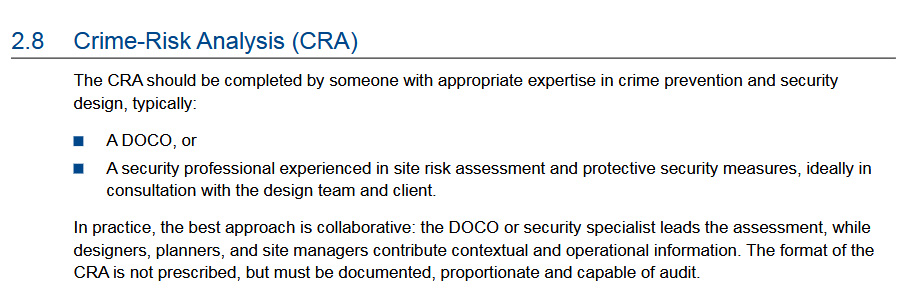
A Risk Assessment, Supported By Industry Experts, Should Always Be Carried Out
What The Guide Actually Asks For
The guide’s approach is simple: address security early, and make it proportionate to the documented risk rather than applying the same checklist to every site. It guides developers through the designing-out-crime process and references the Security Overlay to the RIBA Plan of Work, a framework developed by the National Protective Security Authority (NPSA), RIBA and Police CPI to build security into standard design stages instead of adding it after the layout is fixed.
Two practical points follow for anyone developing a site now. First, risk assessment needs to come before specification, not alongside it or after it, because a site beside a busy road with strong natural surveillance faces a very different risk profile to a remote site reached by an unmarked farm track. Second, the guide highlights that solar farms are especially exposed during construction, when high-value equipment, cabling, materials and temporary infrastructure are on site before permanent security is fully in place, so developers need both a construction-phase plan and a permanent one.
The route through both is clear: involve a Designing Out Crime Officer and a specialist perimeter security partner during design, not after planning submission. It is a named process, not something developers are left to invent for themselves.
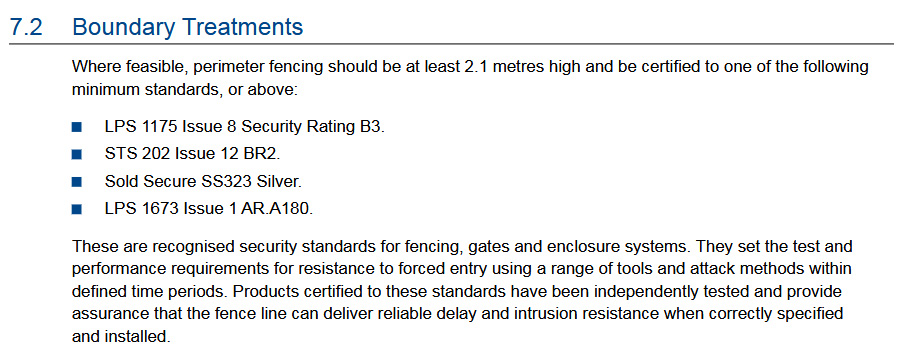
A Higher Level of Perimeter Barrier Is Now Recommended For Solar Farm Developments
What The Guide Actually Requires At The Perimeter
The guide sets a clear baseline: perimeter fencing should be at least 2.1 metres high and certified to one of a small number of recognised standards — LPS 1175 Issue 8 Security Rating B3, STS 202 Issue 12 BR2, Sold Secure SS323 Silver, or LPS 1673 Issue 1 AR.A180. These standards test a fence’s resistance to forced entry using defined tools, methods and time thresholds, so the key point is not just that the fence resists intrusion, but that it provides a documented delay time.
That delay is what makes the rest of the security package work. Detection measures such as PIDS, VSS and audio challenge only have real value if there is time between an intrusion starting and a response arriving, which is why the guide treats them as compensatory measures where certified fencing is not used. In its own words, deer and stock fencing is “not security certified” and offers no proven delay, so a camera watching an unprotected fence is only recording an intrusion after it has already happened.
Gates and hardware are subject to the same logic. If certified fencing is used, gates must provide equivalent resistance, and even where a deer-fencing compromise is agreed elsewhere, the main vehicle and pedestrian gates still have to meet a certified standard. Padlocks and shrouds are expected to be certified and tamper-resistant too, not generic components that add no real delay.
The layout matters as well. The guide requires a buffer zone between the perimeter fence and the panel array so that panels or cable have to be moved a meaningful distance before they leave site, buying time for detection and response to work properly. Deer fencing is not banned outright, but it is only acceptable as part of a compensatory package, agreed with a DOCO, where certified fencing genuinely cannot be achieved; used as the default, it leaves every other layer of security working against a clock that never started.
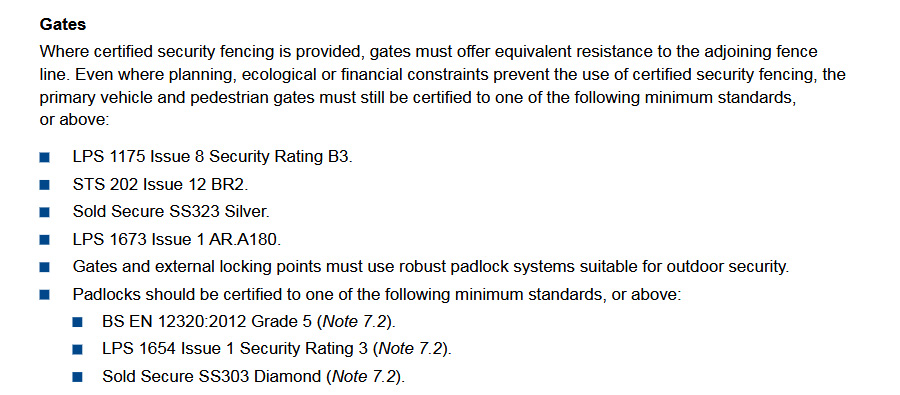
Gates Are Potential Weak Points, So Should Be Specified To A High Standard
Where Alexandra Can Help
None of this needs to mean more complexity for the developer. Adding a layer of risk assessment and specification into the design process sounds like extra work, but done properly, it removes work rather than adding it. The security decision only has to be made once, correctly, rather than revisited after a DOCO objection or a first theft.
This is where Alexandra Security fits in. We specialise in perimeter security for utilities and critical national infrastructure, having helped specify and supply security for projects including Sizewell C, HS2 and Millbrook Power Station. The same risk-based approach we use on that kind of site; start from the threat, not the catalogue, translates directly to solar. A treatment works and a solar farm are different assets, but the underlying question is the same: what is actually at risk here, and what does the perimeter need to do about it.
In practice, that means we can support a development at exactly the point the guide says matters most; before planning submission, not after. We carry out pre-planning risk assessments and produce specifications aligned to the new guide’s requirements, covering fencing, gates and hardware to the certified standards it sets out. Where useful, we can also liaise directly with Police DOCOs to confirm a proposed specification meets their expectations before it goes anywhere near a planning application. Closing off exactly the kind of objection Wakefield’s DOCO raised, before it becomes a delay.
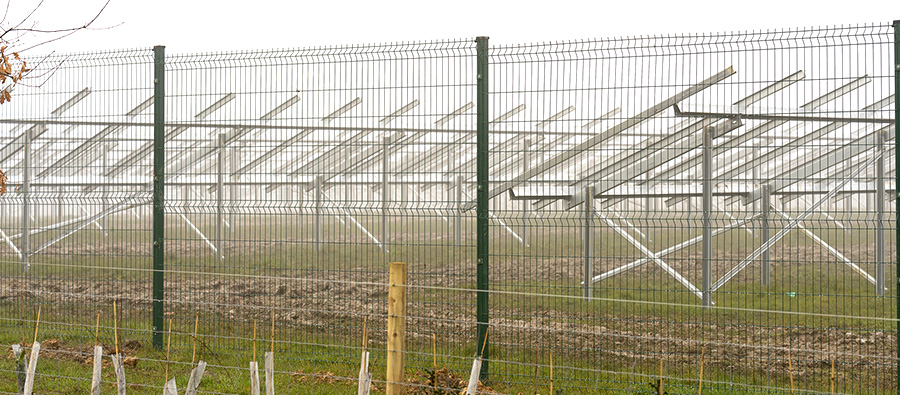
Above: Potash Farm Solar Farm Integrated Deer Fencing Together With Mesh Security Fencing
The support doesn’t stop at planning. Once a specification is agreed, we manufacture and supply the fencing and hardware itself, and can bring in vetted sub-contractor installers with direct experience on solar sites. This reduces the gap between a spec being finalised and a site being secure, and gives a project manager one point of contact across the whole process rather than several.
If you’re currently specifying or reviewing perimeter security for a new solar development, the new SBD guide is worth reading in full before anything is finalised. If it would help to talk through what it means for your site specifically, we’re happy to.
Being a manufacturer means we have a complete range of security fencing and gates that meets these new SBD guidelines. Our SolarGard range includes SR1 rated solar farm perimeter fencing that meets LPCB A1 standard. If your site needs extra protection, our Protek Elite Defender SR2 system meets B3 standards, giving a certified attack delay of 3 minutes. It’s single skin design also means it blends in well with rural areas, especially when powder coated green or black. We can also work with your specific site needs, such as the requirement for earthing of the perimeter fencing, as well as gates for wildlife access.
We’ve helped operators, contractors, and designers across the UK protect their renewable energy sites with proven perimeter security solutions. Whether you need advice, product specifications, or a complete fencing system, our team is here to help. Get in touch to start the conversation on your next solar farm’s perimeter security.

Our Team Is Happy To Support Your Solar Farm Planning Application With Our Security Expertise