


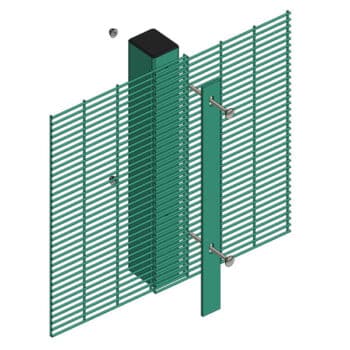
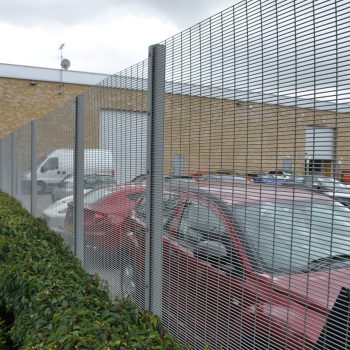
Protek® 358 Elite – SR1/A1 Rated Prison Mesh Fencing
SR1 Rated 358 Flat Panel Security Fence System Protek 358 Elite is an improved version of our standard prison mesh…
FIND OUT MORE
A fence that only looks strong is a liability, not a control. If your site holds critical infrastructure, sensitive data, or high-value assets, your perimeter needs to do more than deter, it needs to have proven, tested, evidenced resistance to attack.
At Alexandra Security, we manufacture and supply security rated fencing systems that go beyond standard perimeter fencing. Every system in our Protek Elite range is independently tested by the Building Research Establishment (BRE) and certified by the Loss Prevention Certification Board (LPCB) to LPS 1175, the UK’s leading standard for forced-entry resistance. That certification is your evidence: verifiable, third-party proof that your perimeter will hold against real-world intrusion attempts, not just a manufacturer’s claim.
Standard fencing might look robust, but without independent testing there is no way to know how it performs under attack. LPCB-certified fencing removes that uncertainty. Each system is tested against defined tool kits for a specified minimum working time, so you know exactly what level of protection you are specifying — and can prove it to insurers, regulators, and auditors.
LPS 1175 is now in its Issue 8.2 revision, which uses a letter-and-number classification (tool category and minimum delay in minutes) alongside the legacy SR ratings that many specifiers still reference. The four ratings most commonly specified for perimeter fencing are:

Resists opportunistic attacks using basic hand tools; screwdrivers, pliers, knives, for a minimum working time of 1 minute. Suited to sites where the priority is deterring casual intrusion and supporting early detection.

Resists more determined attacks using higher mechanical-advantage tools; bolt cutters, claw hammers, drills, for a minimum working time of 3 minutes. Suited to sites facing a higher threat level or requiring a longer delay to support response times.

Resists deliberate, sustained forced entry using more powerful tools including short axes, chisels, crowbars, and battery-powered tools, for a minimum working time of 5 minutes. Typically specified where the threat assessment goes beyond opportunistic crime, such as higher-risk CNI and government sites.

Resists determined, well-equipped attacks, including power tools such as grinders and reciprocating saws, for a minimum working time of 10 minutes. Reserved for the highest-risk perimeters, including critical plant areas and sites hosting government or defence workloads.
Our security rated systems are specified across some of the UK’s most sensitive and highest-value sites, including:

Water and wastewater sites, electricity substations and generation, solar farms, and battery energy storage systems (BESS)

Protecting server halls and critical plant from physical intrusion and opportunistic crime

Including high-speed rail and freight infrastructure
Where threats and potential risk are critically important.

Often have elevated security or insurance requirements
Across these sectors, fencing has to satisfy more than a site manager’s judgement — it has to satisfy insurers, regulators, and increasingly the planning process itself. LPCB-approved fencing gives you evidence-backed protection that stands up to scrutiny from all three.
SR1 Rated 358 Flat Panel Security Fence System Protek 358 Elite is an improved version of our standard prison mesh…
FIND OUT MORE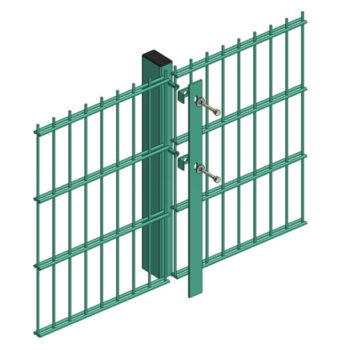
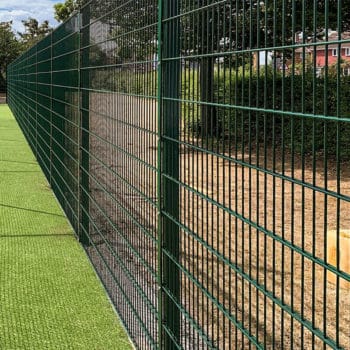
SR1 Rated 868 Twin-Wire Mesh Fence System Protek 868 Elite is an improved version of our 868 twin-wire system which…
FIND OUT MORE

B3/SR2 Rated Single-Skin High Security Fence System Protek Elite Defender sets a new benchmark for high security LPCB fencing. Fully…
FIND OUT MORE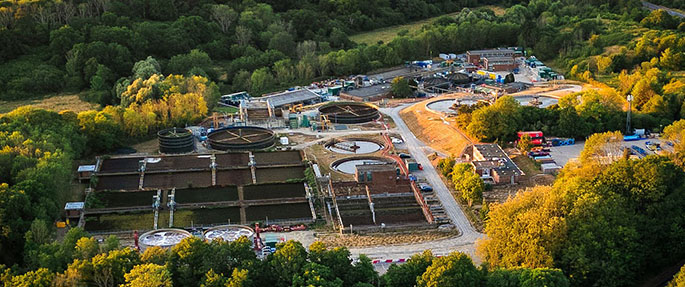
Utilities operators are under growing pressure to evidence perimeter security, not just describe it. Water companies face DWI enforcement and SEMD security obligations; energy and generation sites are increasingly assessed against CNI-specific standards rather than general commercial guidance.
Our Protek Elite systems are specified against these frameworks, giving water, energy, solar, and BESS operators a fencing solution that is built for the compliance environment they actually operate in — not a generic commercial spec adapted after the fact.
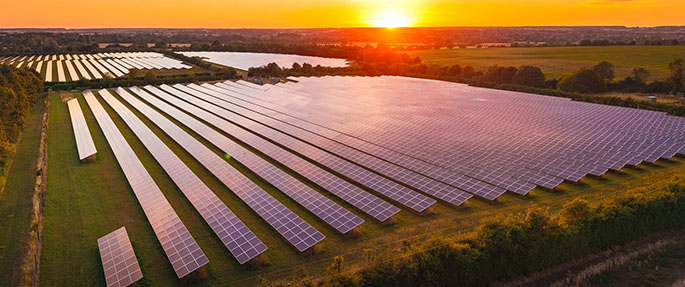
As solar and battery storage capacity expands across the UK, perimeter security has become a bigger factor in planning approval and insurance terms, not a secondary consideration.
Our fencing systems are specified in line with the Secured by Design Solar Farm Guide, giving solar and BESS developers a perimeter that supports both planning conditions and asset protection from day one.
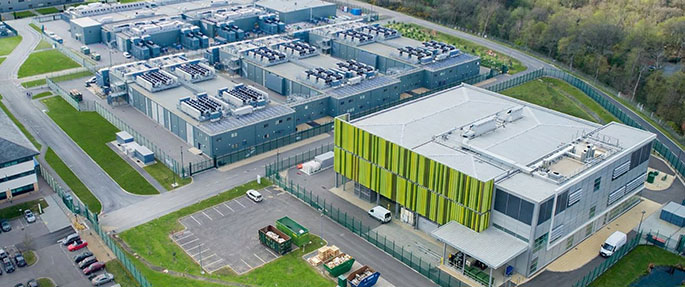
As data centre development continues to expand across the UK, the need for effective, evidenced perimeter protection has become critical. Our data centre security fencing is designed to safeguard sensitive assets and server infrastructure from both targeted intrusion and opportunistic crime.
With options rated to SR1 and SR2, our Protek Elite range ensures your perimeter aligns with current LPCB and Secured by Design standards — helping meet planning conditions and insurance requirements while maintaining operational resilience.

The UK's Police Crime Prevention Initiatives (Secured by Design) programme recommends security rated fencing for projects where a higher level of protection is required. Specifying LPCB-certified fencing can also help projects meet planning conditions and align with insurance requirements — turning your perimeter from a cost line into a point of evidence during due diligence.
We supply a range of LPCB-certified high security fencing systems under our Protek Elite brand. Every site is different — the fencing that's right for a water treatment works is not necessarily right for a data centre perimeter or a solar farm boundary. Our team will assess your site, understand your operational priorities and threat level, and recommend the Protek Elite system that fits.
SR1 (A1) fencing resists an opportunist attack using basic hand tools for at least 1 minute. SR2 (B3) fencing resists a more determined attack, from tools such as bolt cutters, claw hammers and drills, for at least 3 minutes. SR2 is typically specified where intruders are expected to arrive more prepared and equipped.
No , LPS 1175 certification is not a legal requirement. However, it is frequently a condition of planning approval, insurance policies or client specifications, particularly on critical infrastructure, government and data centre projects, and it is recommended by Secured by Design for higher-risk developments.
Most UK data centre and substation perimeters are specified at SR1 or SR2, based on a site-specific risk assessment. SR2 (B3) is increasingly the default for data centres, with higher ratings reserved for the most sensitive compounds. A risk assessment should always confirm the appropriate classification level. A layered perimeter system will often use both SR2 and SR1 compounds.
BRE's test engineers physically attack the fencing using the toolset defined for the target rating, from hand tools up to battery powered cutting equipment. Certification is only awarded if the system prevents an elliptical test block passing through the barrier for the rating's minimum attack time. The testing time only includes the actual time of the physical attack. Testers are allowed unlimited time to prepare as well as pause between attacks.
Issue 8 is the current version of the LPS 1175 standard. It replaced the single SR1–SR8 scale with a two-part rating , a letter (A–H) for the attack toolset and a number for the delay in minutes, allowing protection to be matched more precisely to specific threats.
For certified high security, tested mesh fencing systems such as 358 prison mesh generally outperform traditional palisade fencing, which is harder to certify against modern attack methods. Palisade remains a strong visual deterrent for general commercial properties; where verified delay matters, specify an LPS 1175 rated mesh system.

Liam Chivers
Estimating Supervisor
From schools to industrial and commercial developments, we supply quality mesh security fencing for a wide range of applications. With our stock levels and a commitment to reliable service, we’re ready to support your project, with our on-time, in-full, zero-defect promise.
Just fill out the form and we’ll handle the rest.


