Published:
Specifying wire mesh security fencing without a clear grasp of the underlying standards is a risk. Visually similar products can behave very differently under attack, and the only reliable way to tell them apart is to understand which industry standard applies and, crucially, the level to which the product has been tested.
Two standards are essential:
- BS 1722-14 – the UK baseline standard for weld-mesh fencing and gates, defining construction, dimensions, and performance expectations.
- LPS 1175 – the security rating issued by the Loss Prevention Certification Board (LPCB), based on testing against realistic attack methods and tools over timed intervals.
Knowing both lets you specify with confidence and defend that specification if challenged.
BS 1722-14: The Baseline Standard
BS 1722-14 is the recognised UK standard for weld-mesh fencing and gates, covering appearance, performance, and safety features for common mesh fencing types. Crucially, the British Standard classifies mesh fencing by function and performance rather than appearance, meaning compliant systems should perform as expected regardless of how they look.
The standard divides mesh fencing into four categories:
1. General Purpose Fencing
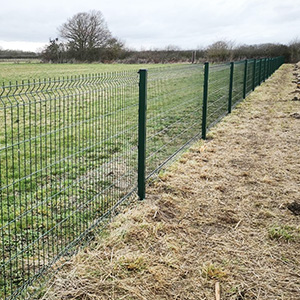
The lowest security category, intended purely for visual boundary marking and not designed to resist cutting or climbing for any meaningful duration. Suitable only for very low-risk areas where a small visual deterrent or boundary demarcation is all that’s required.
Typical characteristics:
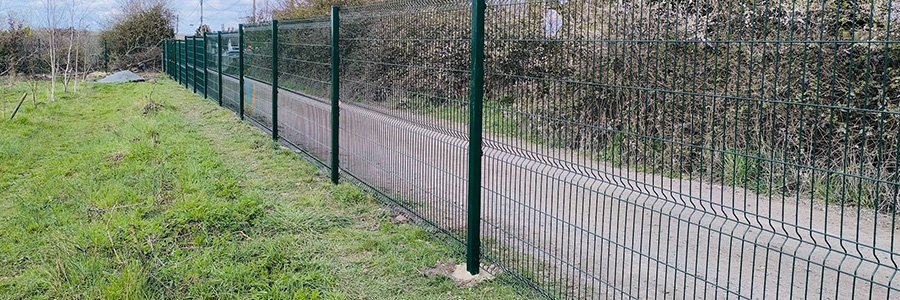
- Single Wire V-Mesh fencing
- Under 2.4m tall (typically 1.8m or 2.0m)
- Horizontal wire of a minimum of 4.5mm thickness
- Vertical wire of a minimum of 3.75mm thickness
2. Boundary Fencing
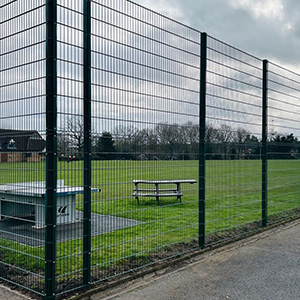
A step up, at a minimum of 2.4 m high, offering a basic deterrent against climbing but still not designed to resist cutting attacks. Appropriate for low-risk perimeters where the consequences of a breach are limited.
Typical characteristics:
- Twin-Wire Mesh Fencing
- 2.4m tall or higher
- Horizontal wire a minimum of 5.5mm thickness
- Vertical wire a minimum of 4.5mm thickness
3. Security Fencing
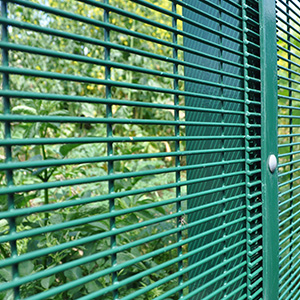
Defined as at least 3.0 m high with a prison-mesh (358-style) panel, designed to resist climbing and provide a basic level of cut resistance. This is the realistic baseline for any site with assets worth protecting; anything below this category should not be considered “security” fencing in a meaningful sense.
Typical characteristics:
- 358 Prison Security Mesh Fencing
- 3.0m tall or higher (typically with anti-climb toppers to reach 3.0m)
- 4mm horizontal and vertical wire thickness
- Tightly spaced apertures
4. High Security Fencing
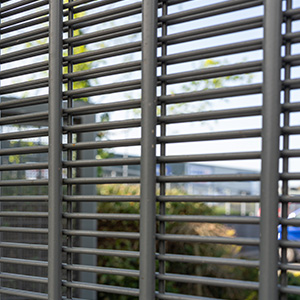
The highest category in the British Standard, defined by fencing at least 3.0 m high and designed to delay determined attacks. High security fencing in the UK usually consists of double-skinned mesh, or mesh panels with greatly increased wire thickness, and is intended for sites where the risk or consequence of a breach is critical. Being much more robust than standard mesh fencing, this type can resist sustained attempts at cutting with tools.
Typical characteristics:
- At least 3.0m tall or higher (often with anti-climb toppers to reach 3.0m)
- 4mm double-skinned mesh, or single-skinned mesh with greatly increased wire thickness
- Tightly spaced apertures
- Often (though not automatically — see below) paired with an LPS 1175 rating.
Wind & Crowd Loadings
A key part of BS 1722-14 is the minimum requirement for wind and personnel (crowd) loading, ensuring the fence line does not fail under strong winds or attempts to push the panel. These requirements differ by fencing category.
Loading requirements by category:
- General & Boundary Fencing – Must resist a 360 N/m line load applied at 1.1 m height, as well as a design wind speed of 38 m/s (equivalent to 900 N/m² dynamic pressure across the panel).
- Security & High Security Fencing – Must resist a 700 N/m line load at 1.1 m height, plus the same 38 m/s wind speed (900 N/m²). Where there is a risk of burrowing, these fences must either be mounted on concrete upstands or have extended mesh buried 300 mm in the ground.
Post foundations for all categories must be strong enough to resist the specified wind and crowd loadings. BS 1722-14 does not prescribe exact foundation dimensions, as required post embedment and concrete sizes will vary with ground conditions and exposure.
As a rule of thumb, at least 30% of the above-ground post height should be concreted into the ground (for example, 0.75 m embedment for a 2.4 m above-ground post), subject to site-specific engineering where conditions are poor or loads are higher.

LPCB Security Rating Standards
BS 1722-14 confirms that a fence is built properly; it does not indicate how long the fence will hold up under attack. That is the role of LPS 1175, the Loss Prevention Standard developed and administered by the Loss Prevention Certification Board (LPCB).
Unlike the British Standard, which is industry-developed, the LPCB is an independent, third-party certification body that tests and certifies security systems (including fencing) against real attack conditions. Its aim is to shift security specification away from visual appearance and manufacturer claims towards a measurable, repeatable performance standard based on defined toolkits and timed resistance.
For specifiers, LPCB certification provides confidence that:
- The fencing system has been tested to a recognised, independent methodology.
- It has been assessed as a complete system (panels, posts, fixings, gates), not just as individual components.
- It delivers a defined level of resistance and time delay against forced entry, expressed as a security rating (for example, SR1–SR8 or A1–H20).
LPCB-certified systems allow insurers, planners, and other professional bodies to understand a site’s level of protection at a glance. They also make the specification of high-security fencing easier to justify and defend during approvals, audits, and post-incident reviews, by replacing assumptions with a standard-tested product guaranteed to perform to a set level
What The LPS 1175 Security Rating Represents
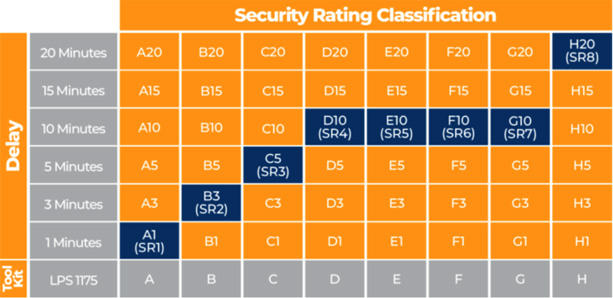
LPS 1175 is the security standard issued by the LPCB that defines how security products are physically attacked and assessed, with ratings awarded based on the level of resistance a product provides under attack. These ratings focus on time delay against defined threats, expressed as a combination of tool category (A–H) and minimum delay in minutes (1, 3, 5, 10, 15 or 20).
It is important to note that LPS 1175 does not cover:
- Visual deterrence
- Resistance to vehicle ramming attacks (which are addressed by separate standards such as PAS 68 / IWA 14-1)
- The ability for intruders to climb over the fencing, either unassisted or with climbing tools
Despite these limitations, LPS 1175 is now very common in the high-security product market, giving specifiers an easy, at-a-glance reference for how a product will perform against forced entry using specified toolkits and attack durations.
How LPS 1175 Security-Rated Fencing Systems Are Tested
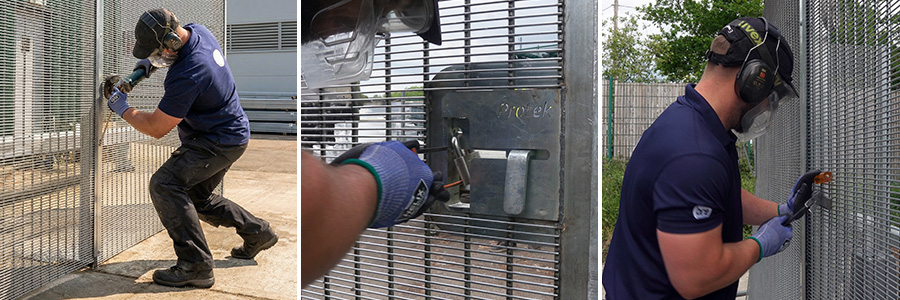
LPS 1175 testing is intentionally rigorous and involves real-world, destructive attack testing by trained professionals. Around 95% of products fail to achieve their intended rating on first submission, reinforcing confidence that the standard is robust.
Systems are subjected to sustained, realistic physical attacks by independent BRE/LPCB testers using defined tools and time limits. An attack continues until access is achieved, the working time expires, or the method is deemed ineffective. The time limit applies to constant attack; if the tester stops, the clock is paused so they can reassess before continuing, and testers are allowed to plan and prepare their attack before the clock starts.
Testing confirms consistent performance across the whole system, not just at a single point: panels, posts, fixings, and foundations are all tested. Any weakness, even after the time threshold, results in failure.
Once a system has been tested and approved, a yearly audit of supplier products ensures that no deviations in design have occurred and that the product still meets the standard it was originally tested to. A public record of all products that meet the standard is available online at www.redbooklive.com.
The LPS 1175 Rating System
The core of LPS 1175 is its rating system, which assigns each fencing system that passes the physical tests a Security Rating (SR), from SR1 up to SR8. The number in the rating represents the minimum time delay (in minutes) that the product has been tested to withstand an attack, relative to the potency of the toolset used.
This system is broadly comparable to the European EN 1627 standard, which also uses time delay and toolset to define ratings (for example, A1 = 1 minute with toolset A; C5 = 5 minutes with toolset C), making it easier for specifiers on international projects to compare performance across markets.
An overview of the rating system:

SR1 / A1 – Testing against basic hand tools such as screwdrivers, small pliers and short-bladed knives. This standard is intended for opportunist intruders looking for quick access.
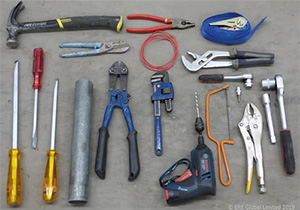
SR2 / B3 – Tested against a wider range of tools, including bolt cutters, claw hammers and hand saws. This standard is intended to protect against more determined intruders who are prepared to spend longer attempting entry.
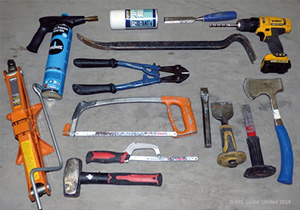
SR3 / C5 – Products certified to LPS 1175 SR3/C5 provide moderate resistance to determined attempts of force using a physical force and a wide range of hand tools with a more significant mechanical advantage, including those that create noise.
The purpose of this system is to simulate real-world conditions, giving confidence that an approved fencing system will perform as intended. It is also important to note that the classification is not linear: products can have more than one rating for which they are tested and approved. For example, a system that achieves SR3/C5 may also resist a higher-spec toolkit for a shorter time (e.g., E1), allowing specifiers to understand all potential applications and build in a total time delay across a site.
SR1 vs SR2 vs SR3: Which rating does your site need?
What Is SR1/A1 Rated Security Fencing
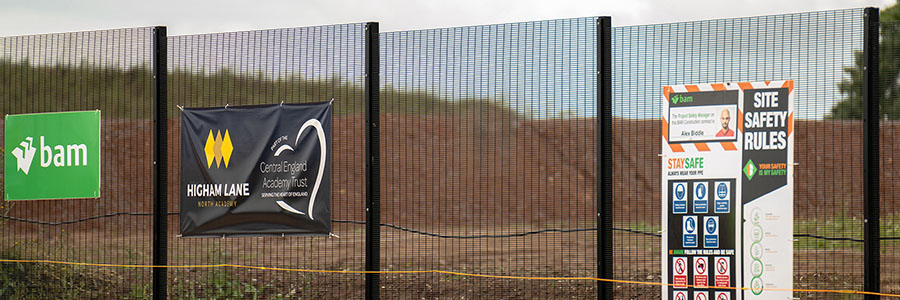
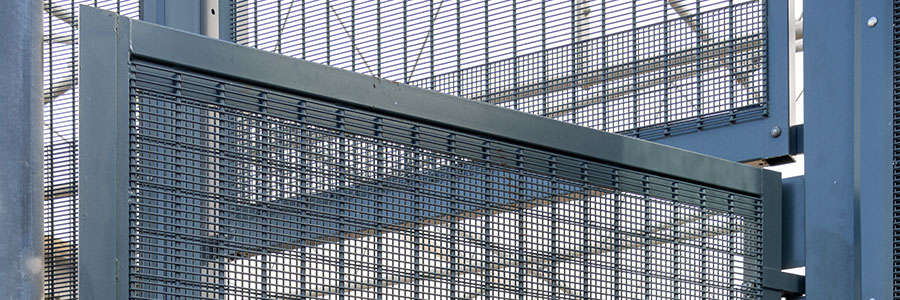
SR1 (A1) provides a baseline 1 minute delay against Tool Set A (screwdrivers, small pliers, and short bladed knives). Fixings on SR1 systems are stronger than those on standard mesh systems and are designed to resist cutting for longer. SR1 is commonly specified where a tested and certified security fencing system is required for insurance purposes, and is often used for internal separation fencing to control the flow of vehicles or people around sensitive areas.
What Is SR2/B3 Rated Security Fencing
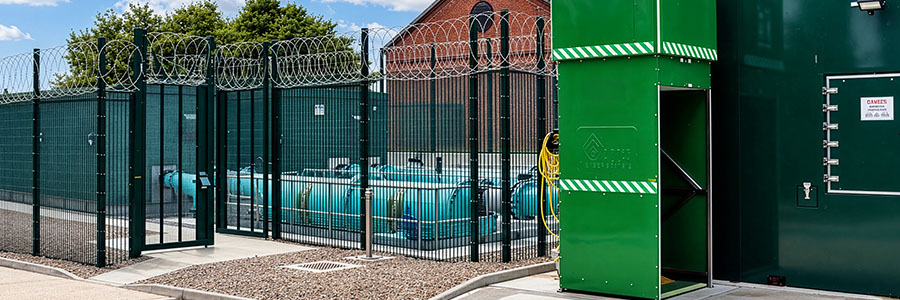
SR2 (B3) provides a baseline 3 minute delay against Tool Set B (bolt cutters, claw hammers, and hand saws). Mesh panels on SR2 fencing systems are stronger, typically using thicker wire or double skinned panels to resist attack for the full 3 minutes. Visually, these systems are more imposing than SR1 and look clearly different from standard mesh fencing. SR2 fencing is commonly specified where assets face a defined risk of attack, and is often used as the main site boundary or as internal fencing for critical assets.
What Is SR3/C5 Rated Security Fencing
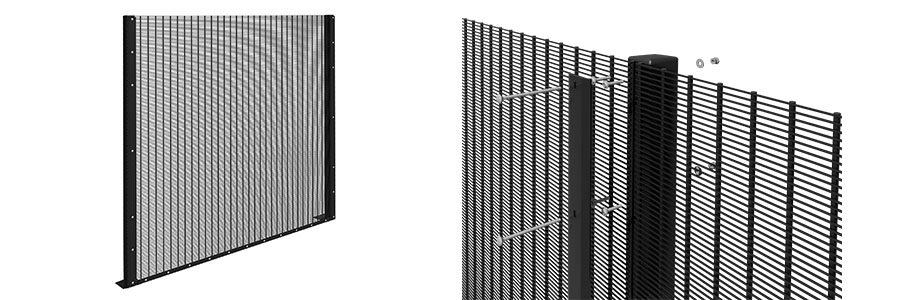
SR3 (C5) provides a baseline 5 minute delay against Tool Set C (larger saws, axes, and powered drills). Mesh panels on SR3 systems are almost always double skinned to provide an extra thick layer of resistance, making them visually very imposing and reducing sightlines through the mesh. These systems are commonly specified for high risk, critical sites where any failure would severely compromise security. SR3 systems can be more complex to install and typically require specialist lifting equipment and installation teams experienced in handling heavy, high security mesh panels.
Our Recommended Specification For LPS 1175 Security Fencing Systems:
SR1/A1 (low risk site that requires a certified security fence) – Protek 358 Elite (Prison Mesh) or Protek 868 Elite (Twin-Wire). This choice often comes down to visuals. 358 mesh provides a higher visual deterrence that makes it more suitable for industrial applications. Twin-wire allows a good level of visibility through the fencing line, making it more suitable for school or public area use. We highly recommend SR1 twin-wire fencing at a minimum height of 2.4m for schools over standard unrated mesh fencing systems.
SR2/B3 (higher risk site that requires a longer delay time to implement a response plan) – Protek Elite Defender. This system has achieved the SR2 standard using only a single-skin mesh panel. This makes it less complex to install compared to some double-skin systems, as well as still allowing good sight levels through the fence for surveillance. In addition, the patented fixing system allows for the entire system to be bolted from the attack face only, removing the need for extra labour time fixing bolts from the reverse side. We highly recommend Protek Elite Defender for infrastructure use, where a defined delay time is needed to protect a high value asset, and an easy to install security fencing system is benefical.
The key takeaway regarding all standards in fencing is that security shouldn’t be an afterthought. It should be deliberate, calculated, & technically exact. Designed for your site. Engineered with intent. This is what these standards assist in creating.
High security perimeter projects in UK infrastructure carry real consequences. That’s why it’s always best practice to work together with a consultant and manufacturer to ensure standards are upheld at design stage. At Alexandra, we can help support your perimeter security project with expertise that will ensure your specification meets requirements.
We’ve worked on many infrastructure projects that require precise perimeter security. Get in touch today and let’s start the conversation on how we can support your security needs.