Published:
When specifying security products, you’ll quickly run into a confusing group of standards, certifications, ratings, and approvals. LPCB, LPS 1175, Secured by Design, CPNI, NPSA, SR1, PAS 24 – the list goes on – and they’re not interchangeable.
Some verify a product’s rigorous testing (independently) against a defined attack. Others indicate the police recognise a product or development approach’s contribution to crime prevention. Others are associated with the protection of critical national infrastructure and government sites, where the consequences of a security breach would be especially serious.
For architects, security consultants, contractors, developers and asset owners, understanding the difference is necessary. Choosing a fence simply because it carries a familiar security logo won’t cut it – the certification or approval needs to actually match the threat, site, specification and required level of protection.
So, what is the difference between LPCB, Secured by Design and CPNI/NPSA, and when might each one be relevant? Let’s get into it properly:
Why Third-party Certification Matters
Security products can’t just be described as “high security” by the manufacturer. They have to be assessed against an established standard by an independent body to verify they’ll actually hold up to the security specifications of their application.
In other words, it’s a matter of “we won’t just take your word for it”.
For high-value or high-risk sites, it’s especially important that independent evidence “proves” the specified security solution is appropriate for the threat.
LPCB: Independent Testing and Certification
The Loss Prevention Certification Board (LPCB), which is part of BRE Group, has developed standards for fire and security performance since 1868. Its standards are internationally recognised in the security and fire industries.
For physical security, likely the most important standard you’ll come across is LPS 1175.
LPS 1175 certification assesses products’ resistance to forced entry, using pre-determined tools and attack methods to subject the product to controlled attack. It considers the security performance of the complete product or system rather than simply awarding a rating to one material. A security fence might be made from heavy-duty steel, for example, but its overall performance will also depend on its mesh, fixings, posts, connections and installation.
What Does an LPCB Rating Tell You?
The security rating tells a specifier how a product performed under the defined test conditions.
LPS 1175 classifications run from A1 through to H20. The number represents the resistance time in minutes, while the letter identifies the relevant toolset, to provide details about the product’s resistance.
This makes LPCB certification particularly valuable when a project has a defined forced-entry requirement.
For example, if a security consultant specifies an LPS 1175 A1/SR1-rated fence, the requirement isn’t “install a strong fence”. They’re asking for something specific – an independently tested performance level.
Secured by Design: Police-Led Crime Prevention
Secured by Design (SBD) is different.
Rather than being a testing standard like LPS 1175, Secured by Design is the official police security initiative, owned by UK Policing, which aims to reduce crime through good design.
Its approach doesn’t simply ask, “How long can someone attack this product?” It looks at security in the design of buildings, developments and their surroundings. It also provides guidance for built environment professionals and accredits products that meet the relevant requirements.
In other words, a Secured by Design approach asks a broader question: How can the design of this place make crime harder and people safer?
For products, the important term to understand is Police Preferred Specification, which can only be achieved by SBD members.
What Does Secured by Design Actually Tell You?
Think of SBD as bringing a police perspective on crime prevention to security specification. It can be particularly relevant to:
- Residential developments
- Housing schemes
- Commercial developments
- Schools and community buildings
- Doors and windows
- Access control
- Boundary security
- Products designed to reduce opportunities for crime
The objective isn’t necessarily to create the most attack-resistant product imaginable. It’s to encourage effective, proportionate security through design.
This makes SBD particularly relevant at planning and development stages, where security fencing can be considered alongside natural surveillance, access routes, lighting, landscaping, etc.
CPNI and NPSA: Security for the UK’s Most Sensitive Sites
Then there is CPNI/NPSA, which sits further along the security sliding scale.
The Centre for the Protection of National Infrastructure (CPNI) used to provide the organisations responsible for national infrastructure with protective security advice. Its work and expertise have now transitioned into the National Protective Security Authority (NPSA).
For security-critical environments, the question moves away from whether a product withstands a particular attack for a particular amount of time. Instead, it asks: Can this add to an effective security strategy for a site with a specific threat?
NPSA has a Catalogue of Security Equipment (CSE) with all the security products and systems that have undergone their evaluation. This catalogue includes physical security measures like fences and gates, including the 358 anti-climb rigid mesh fencing systems.
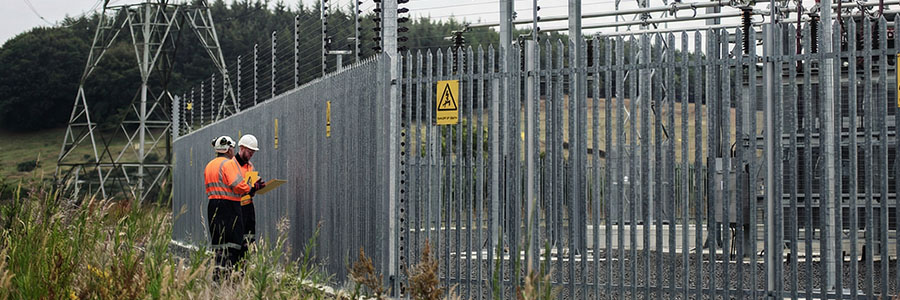
NPSA accreditation is particularly relevant to sites where a security breach could have consequences extending well beyond straightforward theft or vandalism. Think:
- Critical national infrastructure
- Energy and utility sites
- Government facilities
- Defence-related locations
- Transport infrastructure
- High-value or nationally significant assets
- Sensitive data and communications facilities
CPNI/NPSA Isn’t Simply a Better Version of LPCB
This is one of the most important points for specifiers.
It would be misleading to think of the systems as a simple ladder:
LPCB → Secured by Design → NPSA = increasingly secure
That’s not how they work. Instead, they address different security requirements.
NPSA notes that the operational requirement and threat should drive product selection. They also emphasise the importance of layered security – detection and delay over relying on a single product.
What Does This Mean for Security Fencing?
Okay, so you’re trying to figure out what accreditation you need attached to the security fencing you choose for a specific site? Let’s imagine three different projects to determine which you’d choose:
A Housing Development
Here the developer may need to demonstrate that the scheme has been designed specifically with crime prevention in mind. Secured by Design principles are most relevant.
A Commercial or Industrial Site
Here, the client may have a clearly defined forced-entry requirement. An LPS 1175-rated fencing system will likely provide the independently tested resistance required by the security specification.
A Critical Infrastructure Site
Here the security strategy will be driven by detailed threat assessments, which are influenced by NPSA guidance and perhaps also the other products listed or evaluated through NPSA.
In this situation, the fence is only part of the overall strategy, because layered security is what’s needed. So you’ll likely also be looking at intrusion detection, CCTV, motion detection lighting, access control and more.
Why, you ask? Well, because a fence can delay intruders, while a detection system can provide early warning. CCTV can provide verification, and a monitored response can turn all of that into an intervention.
So the strongest perimeter isn’t necessarily the one with the most imposing fence. It’s the one where the security measures work together. We’ve explored this in more detail in our blog on the integration of fencing with detection systems, if you want to learn more.
Does an LPCB-Rated Fence Also Need to Be NPSA-Approved?
No, not necessarily.
Whether it needs one, the other, or both is all up to the project specification and threat assessment.
For a project where an LPS 1175 rating is specified, substituting a different, more secure-sounding certification won’t actually satisfy the requirement.
Likewise, a critical site certainly can’t assume that an LPCB rating will satisfy an NPSA-led security specification.
Always specify against the actual requirement, rather than choosing a certification based on the logo on the product brochure.
Can a Product Have More Than One Accreditation?
Yes, it absolutely can – standards and accreditations aren’t mutually exclusive. A product may be tested against a particular physical security standard while also being suitable for a development designed around Secured by Design principles or being included on the NPSA catalogue.
The important thing is to establish exactly what’s been tested, who’s assessed it, what configuration was tested and what the certification or approval actually covers.
This last point is easy to overlook, so we’ll add a note on that: A certification may apply specifically to a particular configuration of a product, including its fixings, posts, gates, topping or installation method. Changing one of those elements may affect the tested performance, so the approval will be specific.

Choosing the Right Security Fencing with Alexandra
At Alexandra Security, we’ve been supplying perimeter security systems since 1986. The depth of experience we bring makes a real difference to our clients, because specifying a fence isn’t simply about choosing the heaviest one available.
It’s about understanding the site, threat, required delay, detection strategy and operational environment, and then selecting a system that brings those elements together.
Our range includes standard and high-security mesh fencing, designed to meet demanding security requirements. Where a project calls for independently tested performance, we can help you identify the appropriate specification and ensure it aligns with your wider perimeter security strategy.
Whether you’re securing a commercial site, solar energy installation, industrial facility or critical infrastructure, our team can help you navigate the difference between standards, ratings and accreditations – and, more importantly, select a fencing solution that’s appropriate for the actual risk.
Explore Alexandra Security’s range of security solutions or speak to our team at 01892 833 001 about your project and the requirements you need to meet.