Published:
When securing a solar farm, a fence, as crucial as it is, should only be your starting point. Today’s threats – from copper theft to vandalism and unauthorised access – require smarter, more connected solutions. So for truly robust perimeter security, CCTV and detection technology must step in.

By combining physical barriers with intelligent systems that can see, sense, and respond to movement in real time, site operators gain more than just protection – they gain visibility, efficiency, and that coveted peace of mind we’re all aiming for.
Whether you’re upgrading from a standard perimeter or designing a new site from scratch, understanding how your fencing interacts with cameras, sensors, and lighting is necessary for designing an effective system. Done right, these integrations transform your fence from a static boundary into a proactive, always-on security system – one that protects your people, property, and investment around the clock.
What Type of Fencing Works Best With CCTV Cameras and Remote Monitoring Systems?
The relationship between fencing and surveillance is closer than many would think. A well-chosen fence doesn’t just secure the boundary – it directly influences the performance of your CCTV and monitoring systems.
Why, you ask?
Poor visibility, glare, or vibration can all reduce image quality or cause false alarms, which makes the system, if not redundant, at the very least ineffective. So, the wrong fence choice undermines even the best possible camera setup.
For solar farms and other large-scale infrastructure sites, integrating fencing and surveillance from the start of the design phase ensures full coverage, minimal blind spots, and reliable event detection. It also helps reduce long-term maintenance and operational costs, as each system complements rather than interferes with the other.
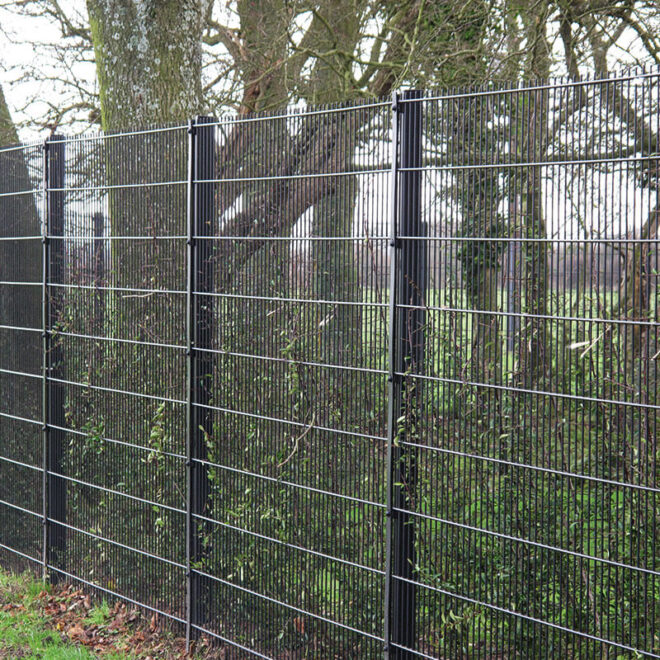
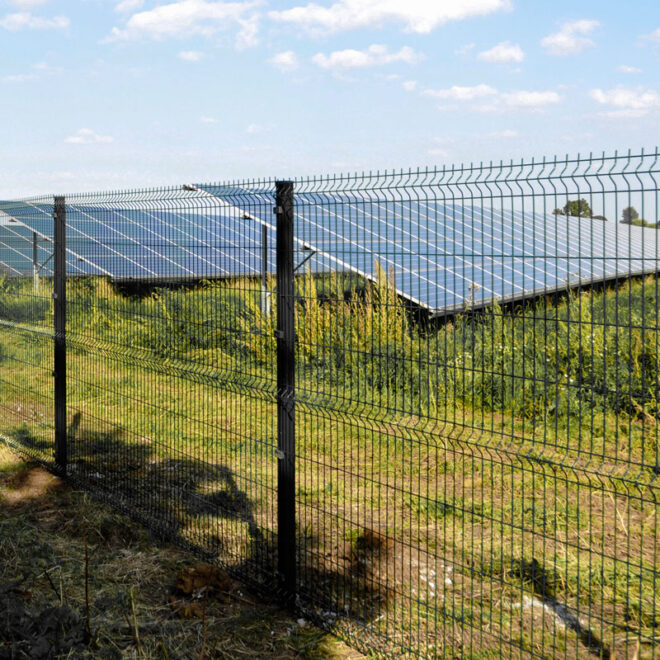
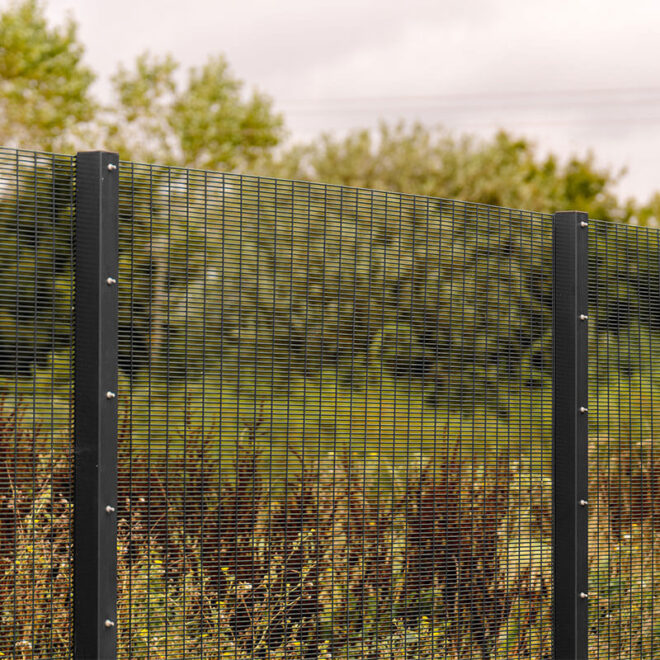
So, the mesh pattern, height, and rigidity all affect how the cameras see and respond to movement – which is why choosing the right specification is critical. For solar farms, rigid mesh fencing such as our Solargard Aurora fencing, Protek 1000 or Protek 868 Clip offers an ideal balance. The mesh apertures are large enough for camera visibility but small enough to resist climbing or cutting, while the panels remain steady in the wind – preventing unwanted motion that could cause false triggers.
Here’s what to look for when integrating fencing with CCTV or remote monitoring:
- Mesh size: Smaller apertures reduce footholds but can obstruct camera views; mid-sized mesh (like 200×50 mm) often balances security and visibility.
- Height: Taller fences (2.4m or above) create better sightlines for cameras and reduce shadowing from solar arrays.
- Design: Avoid fencing with solid infills or decorative panels that block visibility – open mesh supports both human patrols and remote camera monitoring.
Basically, your fence and your CCTV should be designed as one system, not as separate components. When done right, the result is a smarter perimeter that actively detects, verifies, and deters potential threats before they escalate.

Deciding Between Fixed, PTZ, or Thermal Cameras For Perimeter Security
The right type of CCTV camera for your solar site depends on the site’s layout, lighting conditions, and how proactive you want your monitoring to be. Each camera technology brings its own strengths (from static coverage to intelligent tracking), and understanding these differences helps ensure you’re not over or under-specifying your system.
Different cameras suit different risk profiles. Here’s what’s important:
- Fixed cameras work best for predictable layouts or where you only need coverage of key sections like gates.
- PTZ (pan–tilt–zoom) cameras can track movement along a fence line, but they must be programmed carefully to avoid leaving blind spots.
- Thermal cameras excel in rural or low-light solar farm environments, detecting movement through fog, darkness, or dense vegetation.
Many solar farms use a hybrid system combining fixed cameras for continuous coverage with thermal or PTZ units at vulnerable points or entry zones. This is a great way to ensure issues are detected before they become real issues.
Where Should CCTV Cameras Be Positioned Along The Fence Line?
Placement matters just as much as technology. Cameras should be:
- Mounted high enough to avoid tampering but low enough for accurate detection (around 3 – 4m is typical).
- Angled along the fence line rather than directly at it, to maximise the field of view.
- Concentrated at gates, corners, and perimeter changes, where intrusions are most likely.
Regular maintenance (like trimming vegetation and cleaning lenses) is vital on solar sites where glare and dust can reduce performance.

How To Integrate Detection Systems With Fencing
Fences and CCTV aren’t where protection should end – detection systems add an extra layer of intelligent security by identifying movement, vibration or impact. Rather than relying on only visual monitoring, these technologies provide a real-time alert when someone interacts with the fence – whether they’re climbing, cutting, or attempting to lift panels. This early and effective warning system allows site security to respond before a breach occurs.
The main detection technologies include:
Vibration or Microphonic Cable Sensors
These are attached directly to the fence mesh and detect subtle vibrations caused by cutting, climbing, or shaking. When integrated with a high-security mesh fence (such as SR1-rated systems), they provide accurate, instant alerts and can even pinpoint the location of an attempted intrusion along the fence line.
Taut Wire Systems
This is a mechanical solution that uses tensioned wires under a constant load. Any attempt to deflect or cut a wire changes the tension and triggers an alarm. Taut wire systems are highly reliable but are typically only used on critical national infrastructure or military sites because they have rather serious installation and maintenance requirements.
Seismic or Ground-Based Sensors
Installed beneath or near the fence line, these systems detect vibrations caused by footsteps, vehicles, or digging. They’re useful for large, open sites where direct fence mounting might not be practical or where early detection of an approach (before reaching the fence) is wanted/needed.
For solar farms and renewable energy sites, microphonic cable sensors are often the preferred choice. They integrate neatly with rigid mesh fencing (like the SolarGard Orbit or 358 systems), are discreet, and can cover long perimeters with minimal visual impact – a key consideration for planning compliance and environmental concerns.
Their sensitivity can also be finely tuned to minimise false alarms caused by wildlife, wind, or nearby maintenance activity. That said, calibration is crucial. Overly sensitive setups can generate “nuisance alerts”, while poorly configured ones might miss genuine intrusions. For that reason, installation and system integration should always be handled by qualified security engineers who can correctly balance detection zones, alarm thresholds, and integration with the site’s existing CCTV or alarm network.
When properly specified, a fence-mounted detection system changes a passive barrier into an active perimeter defence – one that detects threats the moment they occur and automatically triggers visual verification through CCTV or alerts to remote monitoring centres.

How to Add Security Lighting That Works With CCTV and Detection Systems
Lighting is essential, but it needs to work with your technology, not against it.
The right lighting ensures that cameras actually capture usable footage, detection systems perform accurately, and intruders are deterred before they ever reach the fence line (it would throw anyone off to be suddenly caught in bright lights when carrying out illegal activity).
For solar farms, which often operate in low-light or remote rural settings, well-designed lighting can make the difference between detecting an incident in real time and missing it entirely.
- White-light floodlights improve camera image quality and act as a visible deterrent.
- Infrared (IR) lighting supports covert surveillance for remote or unmanned solar farms.
- Dual-mode systems automatically switch between visible and IR depending on alarm status.
- Mount lighting high enough to cover both fence and ground without creating glare or shadows that obscure CCTV visibility.
A good, well-integrated lighting setup ensures that both detection sensors and cameras work optimally, delivering consistent monitoring around the clock, even in challenging weather or low-light conditions.
Power and Connectivity Options
Even if you have renewable energy on-site, maintaining consistent power and connectivity for perimeter systems requires planning. A single weak link (whether it’s a dead battery or a dropped network connection) can compromise site security.
- Mains power provides the most stable supply for CCTV, sensors, and lighting. However, it often requires trenching for cabling and careful routing to avoid interference with underground conduits or existing solar infrastructure.
- Solar-powered units with integrated battery storage offer an independent solution for remote or hard-to-reach sections of the perimeter. These are especially useful for temporary installations or when extending security coverage beyond the main array.
- Hybrid setups are increasingly common – combining grid-fed power for the core system with solar-powered support for outlying devices.
- Network connectivity should always be secure. Use encrypted wireless links, fibre cabling, or VPN-enabled remote access to safeguard data streams from interference or hacking attempts. Redundancy, like backup communication links, adds resilience in case of outages.
Can I Upgrade My Existing Fence to Support CCTV or Detection Systems?
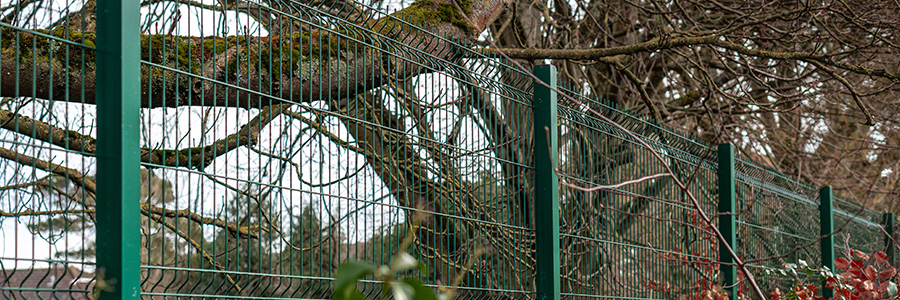
In most cases, yes, especially if you’re starting with a robust, rigid mesh or palisade fence. Retrofitting detection cables or mounting cameras onto posts is pretty straightforward if the structure is in good condition.
Before integration, check:
- Post spacing and strength to support additional equipment.
- Grounding and electrical safety – essential for combining fencing with live electronics.
- Manufacturer compatibility – not all sensors attach securely to every type of fence.
If your fence isn’t up to the task, upgrading to a system like SolarGard fencing or Protek 1000 ensures a stable, high-quality base for any and all electronic integration.
Choosing The Right Solution For Your Solar Farm
An effective perimeter security system combines strength, detection accuracy, and visibility. For most solar farms, this means combining a rigid mesh fence with integrated sensors, CCTV, and lighting, all designed to work as a single, effective system.
At Alexandra Security, we supply UK-made, security-rated mesh fencing systems trusted across the renewable energy sector, and designed for easy integration with the latest technology.
Explore our range of SolarGard security fencing or mesh fencing systems, or speak to our team at 01892 833 001 for assistance in choosing a fence that meets your site’s security, sustainability, and budget requirements.